

5 Book Event Ideas That Aren’t Just “Reading & Signing”
Realistic book event ideas that people actually want to attend

When your book’s publication date is looming, and it’s time to start thinking about a potential tour (or even just a few local events), there’s one major question on every author’s mind: Well, what kind of event can I offer?
Bookstores—particularly large ones, metropolitan ones, or ones with cult followings (like, say, Books Are Magic in Brooklyn)—are often pitched far more author events than they can realistically accommodate. Understandably, that means many event ideas get turned down.
Not only do you need to be able to prove that you can bring an audience in (though, admittedly, this is not a hard rule—some bookshops have such loyal customers that they can reliably provide the audience), but you also need to come up with an event idea that makes the bookstore owner go, “I think our customers would really like that.”
If you’re looking to learn more about author tours and how publishers make decisions about who gets sent on them, check out this post:

Of course, sometimes the easiest idea (i.e. a book reading) is the best idea. Say you’re an author with an established following releasing the much-anticipated second book in a series. Or, perhaps you’re a poet or a narrative-focused author where it’s the actual style of prose that draws in the audience. Or, maybe you’re a celebrity, you already know a zillion people are coming no matter what you do, and a reading and signing is simply the path of least resistance.
All that is well and good. But if you’re looking for a few creative options to spice up your next book event, I’ve cobbled together some ideas from events that I’ve actually pitched and executed. Nothing outlandish here, I promise!
They might not work for every style of book or author, but hopefully they provide a jumping-off point for inspiration.
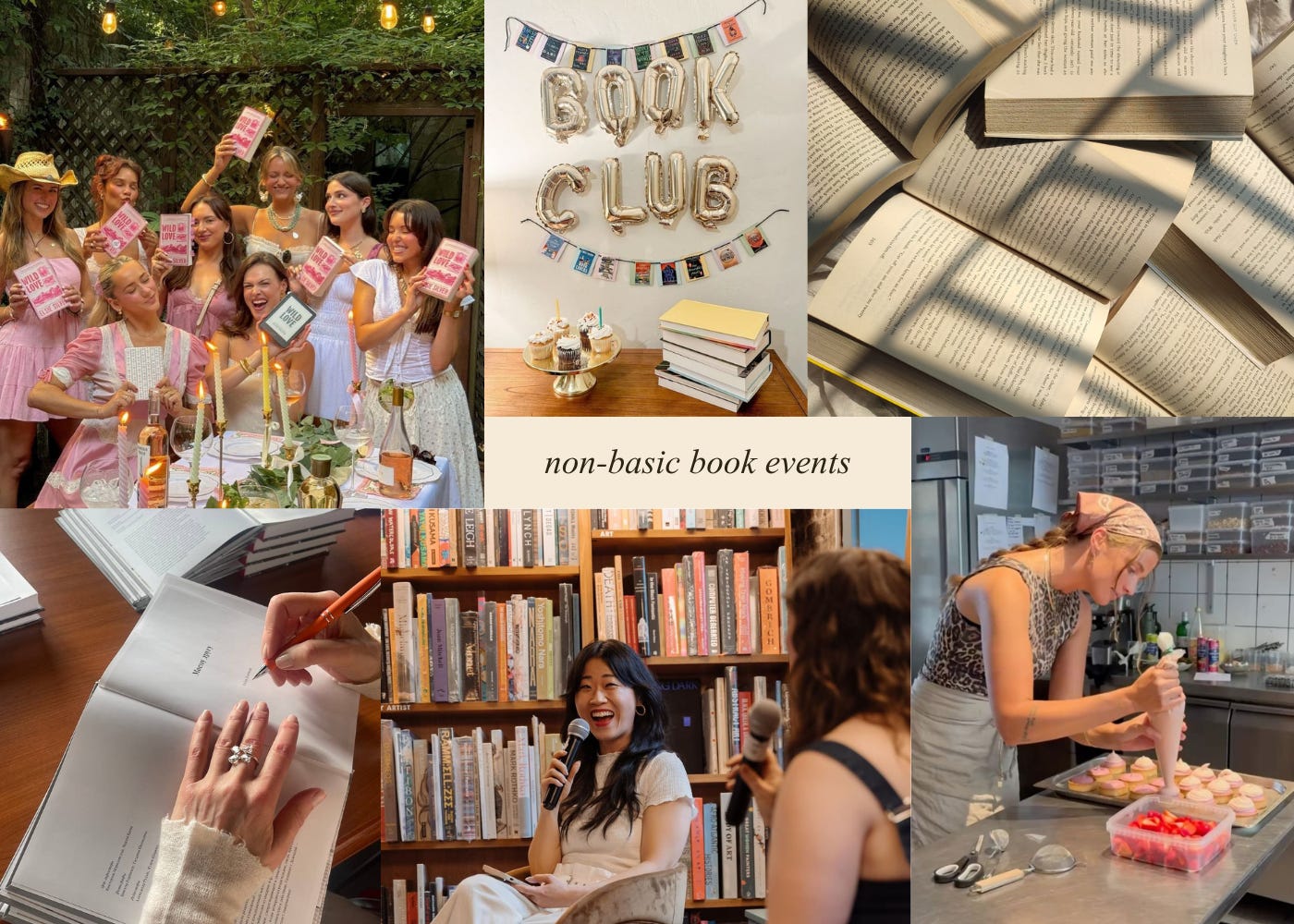
1. Moderated Q&As
This is one of my go-tos. Moderated Q&As tend to go over really well because:
They take the pressure off the author to monologue for 45 minutes
A well-chosen moderator can bring in a whole new audience
Moderators inside of the “field” or industry of the book’s topic can often think of engaging, deep-dive questions that the average attendee might not come up with on their own
They provide structure to what might otherwise become a very chaotic (or very silent) Q&A
When choosing a moderator, I want you to picture a Venn diagram, with people who would read your book in one circle, people who are part of the moderator’s audience in the other, and a sizable overlap in between. Not only does this help you break out of your bubble a little bit, but if you have the opportunity to pair up with a “big name” moderator who perhaps has a larger social presence than you, it’s a better guarantee of butts in seats.
Some examples of who to ask to moderate your event:
A journalist who covers a similar beat as your book (like a cookbook author asking a food or restaurant editor)
An influencer or podcast host in a related niche (like a motherhood self-help author asking a parenting podcaster or creator)
A figurehead within the industry related to your book (like a business author asking a startup founder or executive)
A local professor or academic specializing in the same topic
A fellow author with audience overlap
Barring all that, there’s also no reason you can’t ask a friend or someone else you trust—they likely know great questions to ask simply by hearing you talk about your book for the last two years.
There’s no strict etiquette when asking someone to moderate your event, but be as polite as possible, offer them a copy of your book (physically, preferably), give them plenty of notice (at least a month is ideal), and ensure they’re actually local.
Please do not ask someone from Los Angeles to moderate your event in San Diego. They are doing you the favor.
2. Workshops
If your book is tied to a physical activity, capitalize on that. More and more, we hear about people craving in-person experiences, and something hands-on is infinitely more engaging than listening to someone read a chapter aloud.
Some examples for workshops include:
A gardening author leading a planting workshop
A wellness author hosting a guided journaling or habit-building session
A craft author teaching a small DIY project
A romance author hosting a trope-writing workshop
A travel writer planning an itinerary-building session
A cookbook author leading a cooking or baking class
A financial literacy author hosting a beginner budgeting workshop
However, it’s important to keep in mind that you will either need to:
Provide any workshop supplies yourself, which can get costly
Partner with an event venue or business willing to charge for tickets to offset materials
Work with a bookstore/cafe/studio that already has supplies and infrastructure available
3. Takeovers
This one works especially well for cookbooks. If you wrote a baking book, you could partner with a local bakery to add one of your recipes to the menu for a day or week to promote the release. Or, if you’re a chef or more traditional cookbook author, consider hosting a restaurant takeover for an evening.
A lot of restaurants are surprisingly open to collaborations because they bring freshness and intrigue to regular diners, but this primarily works if you:
Have experience working in a commercial kitchen
Already have a local following
Are friends with the restaurant or bakery owner
Then again, it never hurts to DM a restaurant/bakery and ask anyway. You can also adapt the “takeover” concept for non-food books, like:
A romance author partnering with a florist or wine bar for a themed evening
A fitness author leading classes at a local studio for launch week
A design or interiors author curating a local shop display
A horror author partnering with an indie movie theater for a screening night
A travel author creating a themed menu or experience at a local cafe
A fashion author curating a bookstore or boutique window display
The point of takeovers is less “host an event” and more “insert your book into a space where your target audience already exists.”
4. Swaps and clubs
Again, rolling off the cookbook theme (I apologize for all the cooking-related examples, but this is my professional lane), bake clubs or recipe swaps are fantastic ways to engage with local communities and have people actually experience your book firsthand. Local bookstores are often keen on this idea because it naturally encourages book sales: everyone needs a copy of the book to bake or cook from in order to participate.
A fun spin on this idea for non-food authors could be a themed book swap, like
Poetry swaps
Zine swaps
Romance “blind date with a book” exchanges
Writing sample critique circles
Comic or graphic novel exchanges
For authors who are a bit more wary of the spotlight, swaps can be a really nice alternative because the pressure isn’t entirely centered on you standing at the front of the room speaking.
Book clubs are a similar extension of this idea. Positioning your event around an existing community can be much easier than trying to build one from scratch.
Some bookstores host recurring in-store book clubs and are often open to selecting a new release as their monthly pick, especially if the author is local or willing to attend the discussion either in person or virtually. Beyond bookstores, local libraries, coworking spaces, alumni groups, and even niche hobby clubs can also make fantastic partners.
5. Festivals and panels
When in doubt, team up with other authors.
Research local book festivals (many major cities have annual ones) and apply to either host a booth or join a panel discussion with similar authors. Heads up: applications for literary festivals often close up to six months in advance, so plan early.
Not only do festivals draw guaranteed foot traffic, but panels also give you the opportunity to create even more Venn diagrams of potential audiences.
Some panel examples might include:
Multiple romance authors discussing modern love stories
Horror writers talking about how they approach writing monsters and villains
Cookbook authors discussing different influences on their recipe-making
Nonfiction authors discussing a larger cultural topic tied to all of their books
Panels are also great because audiences are often more willing to “take a chance” on a new-to-them author when they’re already attending for a broader topic or another speaker on the lineup.
Bonus: what not to do
One thing I’ll also say: bookstores can usually tell when an event concept hasn’t been fully thought through. Vague ideas like “a fun literary night!” without an actual structure, events that require an insane amount of setup from the store, or pitches built around unrealistic attendance expectations tend to be harder sells.
At the end of the day, booksellers are trying to evaluate two things very quickly:
Does this sound logistically manageable, and
Is there a clear reason someone who hasn’t heard of this author would attend?
The strongest event ideas are usually the easiest to explain in one or two sentences. If the concept immediately paints a picture in someone’s head, you’re probably on the right track.
At the end of the day, the best book events are usually the ones that give people a reason to care beyond simply “the author will be there.” Readers want experiences, conversations, community, expertise, or entertainment—AKA, something that feels worthy enough to leave the house for.
That doesn’t mean every event needs to be wildly innovative or require a massive budget, but it does mean that putting a little extra thought into the format can go a very long way.
What’s been the best book event you’ve ever attended? Drop a comment below!
Unsolicited Manuscript is an independently run newsletter. All opinions are my own and do not reflect those of my employer, company, or any other institution.
Having a “hook” for your event has become increasingly necessary, and I LOVE all these ideas. I love suggesting an author demo a recipe, drink, or hobby featured in the book. I’ve had artists live paint at a festival booth to promote their book of graffiti art, and absolutely co-sign on having a “conversation partner” for the event who is perhaps a local personality or author who brings their own crowd. Get “sponsorships” from a local restaurant, distillery, bakery and feature their products in return for promo to THEIR audience. I could go on for days and honestly wish book events were more profitable for lesser known authors so I could genuinely recommend and work on them more.
Workshops are my go-to, but moderators are such a good idea (and so much simpler!) I love that takeovers are a thing. (I’ve considered it before but been afraid that it was too weird to pitch.) What is a bake club and why have I never heard of them?!? Sounds fun! Thanks for another great list!