


“Aren’t you worried about AI?”
“Do kids even read these days?”
“What about something with more upward mobility?”
“Wow, I wish I could be as brave as you.”
Anyone who’s ever announced, I want to be an English major or My dream is to work in publishing, has likely endured a version of these statements.
There are the usual suspects: your college counselor, your family members, even ChatGPT when you ask for cover letter advice. Then, even worse, there’s the cautionary talk from people already working in publishing.
When I first graduated college and entered the unemployment vortex, I called a handful of friend-of-friend-of-neighbors-and-strangers for job advice. At least three of them told me, “If I were entering the workforce today, I probably wouldn’t apply for the first roles I took when I graduated.”
In other words, even insiders sometimes look back at their own careers and scratch their heads. That can be tricky to hear, but it also isn’t the universal truth. I might still be in the early years of my career, but I wouldn’t trade it for anything.
If you’re drawn to publishing but feel yourself hesitating every time someone questions your choice, this is for you. The unease around working with books didn’t appear out of nowhere, but it also isn’t the full story. What I want to offer here is a reality check: why this fear exists, how it gets passed around, and what it really means to be young in publishing now.
Things are different now
It’s true that things in the publishing industry have changed. Just look at magazines and newspapers. Media consumption is different now, and everyone—from editorial to production to sales—has felt the shift.
Even beyond publishing, if you ask anyone in broader PR and marketing, they’ll tell you that their jobs aren’t what they used to be. No one watches live TV anymore. An interview in PEOPLE won’t guarantee sales. Paying influencers thousands of dollars for a product placement is the norm. AI can pitch a thousand podcasts in the blink of an eye.
It all can seem very dramatic. But maybe it’s less a crisis and more a reminder that the work you start doing likely won’t look exactly like what you end up doing in ten years.
Yes, it’s hard to get in
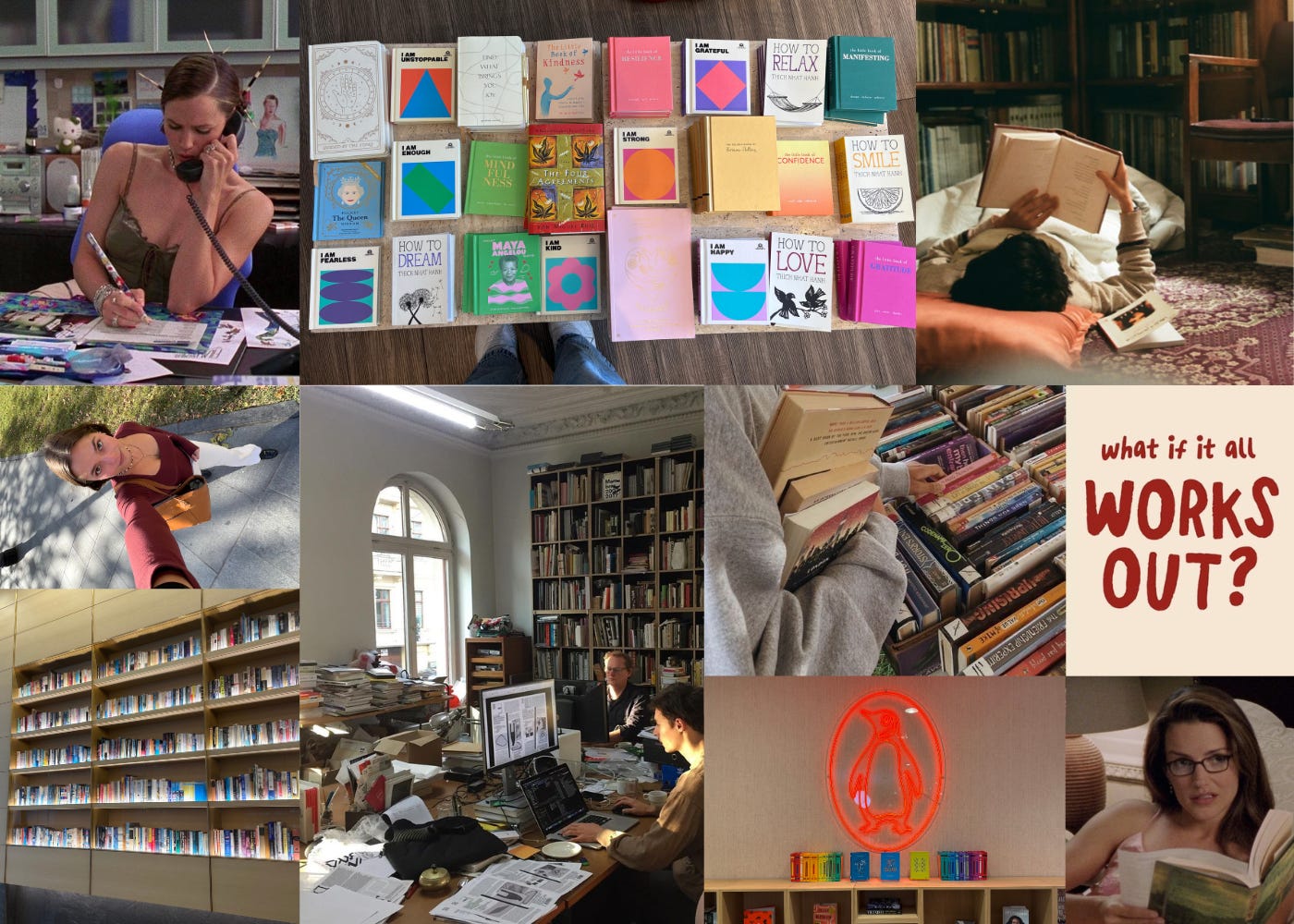
Before you say it, I know: getting a job in publishing right now is hard. Brutally so. Positions are limited, assistant bottlenecks are real, and hundreds of applicants often compete for a single role.
And on top of that, unpaid internships and low entry salaries can end up filtering out anyone without a financial cushion. At the end of the day, family support, geographic flexibility, and the ability to weather lean years still matter far more than they should1.
So, yes, the difficulty is real. But difficulty isn’t the same thing as decline, even if it often gets framed that way.
It’s no wonder a lot of my peers find themselves thinking: Should I give up before I even start?
Changing doesn’t mean disappearing
The nay-sayers certainly want you to. Publishing is dying, they say. The market’s too saturated. Attention spans are dwindling. It’s only a matter of time before AI takes over. Why place your bets on a volatile, underpaying industry when you could be doing something else?
To them, I reply: Because if we let fear stop us, then publishing will die.
Here’s the part that often gets lost: publishing isn’t actually collapsing the way people claim it is. Post-pandemic book sales didn’t crater; they stabilized. Since sales peaked in 2021 at 839.7 million copies, they’ve settled at levels higher than before the pandemic. In fact, print book sales rose for the second straight year in 2025.
And that’s just print copies. Audiobook sales have surged, topping over $2.2 billion in the U.S. in 2024 and climbing sharply in markets like the UK, where audio revenue jumped 31% year-over-year. Meanwhile, social platforms like BookTok continue to drive tens of millions of print sales, especially among younger readers, suggesting that reading isn’t disappearing; it’s just showing up in different places and formats.
Sure, growth in publishing isn’t as predictable as in healthcare or fintech, but if you fell in love with books, you probably weren’t drawn to publishing for its stability anyway.
Youth isn’t a liability
Now, here’s my honest-to-God belief: being young in publishing isn’t a gamble; in many ways, it’s an advantage. While people with ten times our experience lie intimidated by the thousands of ways the media changes every day, we see opportunity.
So what that a feature on The View doesn’t tick the sales needle anymore? Las Culturistas does. So what if salons and doctors’ offices don’t stock print magazines anymore? No problem—Vanity Fair’s Instagram account reaches 10M people. So what if buyers don’t trust listicles? There’s a Substack for that.2
On one hand, you could argue that I have twenty years of experience that I need to catch up on. But on the other hand, I might point out that not everything from those last twenty years is even relevant to the modern market. There’s no need for me to adjust my strategies to accommodate the age of podcasts and BookTok, because they’re all I’ve ever known.
Give me what you’ve got, boss. I’m on it.
And if we don’t know how to do it, we’ll find a way. Because if I’ve learned anything about my fellow Gen Z-ers, it’s that we’re pros at adapting. Give a twenty-year-old a YouTube video, and don’t be surprised when they learn how to code a website from scratch in half a day.
But true success isn’t a competition
All this isn’t to negate the experience of more senior publishing professionals. Trust me, they have so much to teach you, and they want to do it. (Generally, if you work in publishing, you love helping people learn. It’s, like, the whole point.)
Luckily, Gen Z and Millennials are much more likely than past generations to ask for help when needed, and that’s one more tool in our arsenal. Schedule sit-downs with your higher-ups. Network with anyone and everyone you can. Never say no to a piece of advice.
The point is
If you’re currently navigating the job application process, I want you to know that there is someone on the other side rooting for you.
Don’t let catastrophic what-if questions stand in your way. If you want to work with books, the only real answer is to work with books.
That doesn’t have to mean a full-time job, either3. Read, review, volunteer, freelance, attend events, start a small project, or help a friend self-publish. There’s enough bookish joy to go around.
The industry will keep changing whether we’re here or not, but personally, I’d rather be part of it, adapting and trying, than sitting on the sidelines wondering what might have been.
Unsolicited Manuscript is an independently run newsletter. All opinions are my own and do not reflect those of my employer, company, or any other institution.
While it certainly doesn’t solve all the barriers to entry, there are some really great programs out there, like Inkluded (an organization that trains and places young people from underrepresented groups into their first publishing jobs) and The Young Publishers Association (a mentorship and networking organization with free virtual and in-person workshops). Getting a job doesn’t need to be a solo sport.
Yes, these examples are all PR releated. I’m a book publicist; it’s what I know. Sue me.
Publishing is a lot like sports. Teams don't win exclusively with veterans, nor do they win exclusively with hot young talent. The teams that win have a balance of players who've been there, done that, countless times, plus younger players with raw ability. Each complements the other.
I have a B.A. in English Literature from Ohio State, a Master's in Publishing from George Washington, AND I work in a global governance capacity for one of the largest academic publishers in the world. I have never gotten any traction on my Big 5 Publisher applications - BUT WE PERSERVERE!