


If you've spent any amount of time on Substack researching book proposals, cookbook publishing, or how literary agents actually think, there’s a good chance you've come across Sally Ekus.
Or, perhaps you’ve seen my recent Q&A in her newsletter?
* Please excuse my shameless self-plug

They say the publishing world is a small one, and if that’s true, then the cookbook publishing world is even smaller. As someone who mainly works on cookbook PR campaigns, it was only a matter of time before mine and Sally’s paths crossed professionally, and then again on Substack.
Fast forward to present-day, and I found myself in the very lucky position of getting to pick Sally’s brain—and even meet her in person. (They say not to meet your heroes, but I think they were wrong. She’s lovely.)
In case you aren’t familiar with her work yet, here’s a formal introduction:
Sally Ekus is a Senior Literary Agent at JVNLA, where she spearheads The Ekus Group, a boutique division that specializes in cookbook, parenting, and full-color titles. She represents a dynamic roster of talent from first-time to long-established authors, including chefs, restaurant owners, professional food writers, digital creators, journalists, and more. She has brokered over 300 book deals with top publishers including Penguin Random House, HarperCollins, Hachette, Simon & Schuster, and numerous indie publishers. Sally also authors the best-selling Substack newsletter Not So Secret Agent, where she provides insight, guidance, and a candid window into the publishing industry. An active leader with deep roots in the food and publishing communities, Sally is on the advisory council for the Julia Child Foundation and is a proud member of the International Association of Culinary Professionals, Women’s Media Group, and The Association of American Literary Agents. Sally is a mom, taco lover, and improviser.
Unsurprisingly, I had a lot of questions for Sally about the state of cookbook publishing. Even as someone working on the “inside,” it’s infinitely valuable to touch base with others in the genre about trends they’re seeing, issues they’re facing, and fail-safe tips they swear by.
* One last note: in this interview, most of Sally’s insights are specific to food publishing. If you’re looking for more top-level wisdom, check out Sally’s mini Q&A over Notes:
Now that’s out of the way, let’s dive into the nitty-gritty.
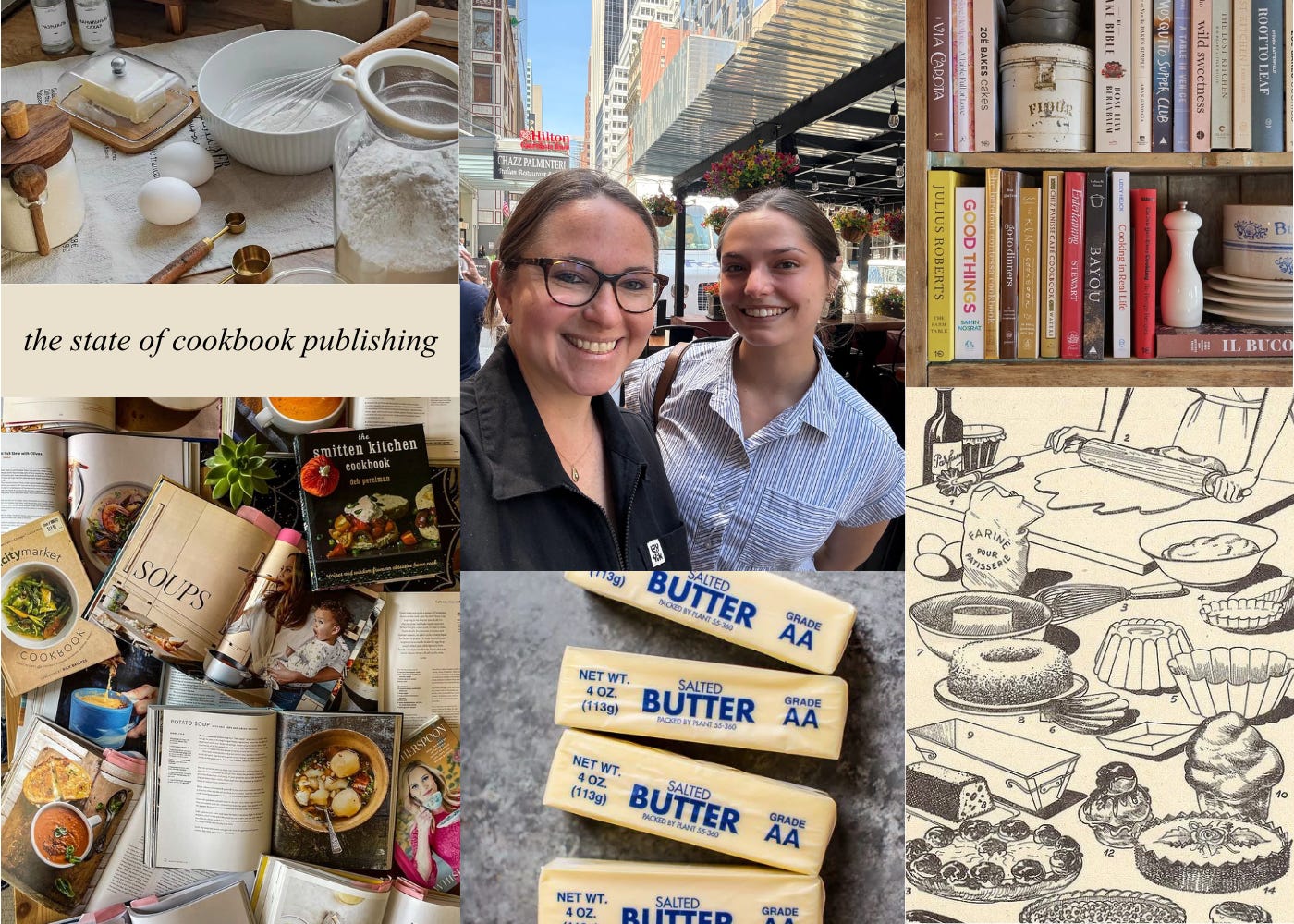
Q: There seems to be a lot more emphasis on aesthetic books and books doubling as lifestyle objects these days. Do you think cookbooks are still treated like practical tools first and pretty objects second, or does it ever feel like it’s the other way around?
A: I don’t feel like it is one or the other. People come to cookbooks for a variety of different reasons. Sometimes as gifts for a loved one or occasion, other times to learn a technique, to take part in a parasocial relationship with a creator or author they follow, etc. The beauty of cookbooks is that the content is highly visual and tactile, so the format itself offers a spectrum of experiences.
* Abigail’s side note (and, yes, I am stealing this format from Sally!): After this Q&A, Sally and I had a great conversation about cookbook aesthetics in person—particularly on the growing trend of illustrated cookbook covers. Personally, I love how they feel both modern and nostalgic, and my over-stuffed bookshelves love how they let cookbooks double nicely as coffee table decor.
Q: Following that, how much do aesthetic and visual branding matter at the book proposal stage?
A: Much like my answer to basically every question in publishing: It depends! Generally speaking, if an author has a strong visual brand online and/or they have strong opinions about what they want their book to look and feel like, I suggest they pitch a designed proposal when it goes out on sub.
I wrote about this more in-depth in my Not So Secret Agent newsletter article Why you should, or shouldn’t, design your book proposal. Last year, of the 12 proposals I pitched and sold, three were fully designed. The rest were Word documents or PDFs.
Q: Food trends seem to come and go so quickly on social media now. Do you find yourself or publishers feeling more hesitant about accepting a trend-led cookbook proposal?
A: A trend-based cookbook is published in a drastically different way than most other cookbooks. They happen on faster schedules and are often based on in-house insights/analytics. Though I dabble in this, the trend-based proposals that are pitched to me don’t often spark my interest.
As the legendary Irena Chalmers said, “The average shelf life of a cookbook is somewhere between milk and yogurt.” If that’s the case, I am not looking to further expedite the spoiling process. 😉
Q: At the same time, some food trends seem to come back around again and again. Are there any food or lifestyle trends that you genuinely think have long-term staying power?
A: I would argue that those are less trends than they are lifestyles or movements. A trend, though incredibly impactful, is short-lived. Cycles in the zeitgeist certainly happen though. Quick & easy, weeknight dinners, 30 mins or less, family-friendly, etc.; all those seem to never go out of style.
Q: There’s so much discourse now around “having a platform” and follower counts in publishing. How heavily do you weigh social engagement compared to actual culinary expertise or proof of concept?
A: To me, it isn’t so much “follower count” versus “culinary expertise or proof of concept.” IMO, expertise and proof of concept need to be clearly illustrated in someone’s book proposal regardless of social media presence.
I am not an agent who has a follower count requirement for the clients I sign. Instead, I look for platform via an established community that the author is already in relationship with in some way. This may be cooking classes, a newsletter, an online following, speaking engagements, etc. Ideally, it is a combination of these things. Just this past year, I signed someone with less than 5k followers on IG, another with 13k email subscribers, and another in traditional journalism.
All that said, having a high follower count helps get my (and editors’) attention faster. I heard somewhere that between 1-3% of an author’s audience will convert to a book order. So, numerically speaking, the reason the industry wants such high numbers is so that 1-3% number translates to high sales. Personally, I believe that strong concept can offset a low platform if the proposal is done correctly.
* Another shameless self-plug: if you’re interested in learning about other ways to stand out to publishers without a social following, I’ve got a post for you.

Q: Online discourse seems to point to the fact that readers are more skeptical of celebrity and influencer products in general these days. Do you think audiences are becoming more discerning about celebrity or influencer cookbooks?
A: I find it fascinating that you’re asking about celebrities and influencers in the same question. Are they categorized similarly from a publicity standpoint? Of course, they both have high-profile opportunities and expectations.
I think if a celebrity or influencer releases any product that isn’t true to their work or identity (or perceived identity), it can lead to skepticism. There needs to be a reason someone publishes a cookbook.
* Abigail’s response: From a PR standpoint, we will often conflate influencers and celebrities—both draw sales from large follower counts, parasocial relationships, and perceived social proof. I think you’ve nailed it on the head exactly: it’s the cookbooks that seem to come out of left field that draw skepticism. I’m thinking particularly of Demi Lovato, Brie Larson, and Dolly Parton’s cookbooks—each one got a huh? from me.
Q: AI-generated text and recipes are increasingly common online, but food feels so tied to personal culture and lived experience. Do you think cookbooks are somewhat “protected” from AI because of that?
A: They are not protected. Hundreds of my clients have had their work stolen to train LLMs, and many are included in the ongoing
Q: Personally, I’ve noticed a huge uptick in bookstores carrying and promoting vintage cookbooks as of late. Do you think this has any relation to consumers being wary that modern cookbooks might be influenced by AI?
A: I noticed this happening before conversations became so dominated by AI concerns. The uptick in vintage cookbooks is the culinary extension of our growing interest in all things vintage and nostalgic. Who doesn’t love a spiral-bound or delicately illustrated collection of recipes?
I could be biased, though, because I grew up in the house that literally holds the Guiness Book of World Records for the largest personal collection of cookbooks. Yup, I have been surrounded by vintage cookbooks for my whole life. And heads up, that record was achieved in 2023 and my mother has not stopped collecting…
* Abigail’s side note: That Guiness World Record is the coolest thing I’ve ever learned in an interview.
* Second side note: AI concerns have infiltrated my every thought. It’s a welcome relief to hear that plain old nostalgia, not fear, is likely behind this trend.
Q: Are there any cookbook categories that simply feel “full” or oversaturated to you right now?
A: I am rarely pitched an idea I haven’t heard before. Approach, style, and individuality set authors apart. As I said before, there needs to be a reason someone publishes a cookbook. We can be sure there will be new baking books, books for getting dinner on the table fast, canning, etc., so authors should ask themselves what is the unique angle they’ll add to the crowded shelf?
Q: And, lastly, what are some books (cookbooks or otherwise!) publishing this summer that you personally have on your radar?
A: My go to source for each upcoming season’s cookbook list is Jenna Helwig’s Cookbookery Collective newsletter. She just released the summer list here. There are trends, vintage recipes, techniques, cookbooks that solve problems, baking, influencer-driven, and so much more. The list, and each season of cookbooks, is a wonderful snapshot of what we have been discussing in this interview.
Thank you!
And there you have it
Going into this interview, I’ll admit I may have been a little preoccupied with some of publishing’s favorite existential crises. AI, influencers, celebrity books, oversaturation... You know, the cheerful stuff.
What struck me most about Sally’s answers is that she repeatedly brought the conversation back to the same core principles that drive a successful book: strong concepts, genuine expertise, distinct perspectives, and community trust. And that, my friends, is someone who has weathered a few tornado warnings and lived to know not every siren is worth listening to.
In an industry that often feels obsessed with how fast everything’s changing, it’s a welcome reminder that the important bits haven’t changed nearly as much as we think.
Unsolicited Manuscript is an independently run newsletter. All opinions are my own and do not reflect the views of my employer, company, or any other organization.