

Do Publishers & Book Buyers Actually Care if Authors Are on Substack?
Why Substack is different from Instagram, TikTok, and YouTube

I was sitting around twiddling my thumbs, wondering what topic to write about this week, when responses to one of my notes sparked some inspiration.
At the office, valuable commentary like this constantly changes how we find authors and decide which books to publish. It’s no surprise that one of the most popular replies on this note was: “Does this apply to other genres besides cookbooks?”
That’s exactly what we’re diving into today.
A quick disclaimer: I work in the specific realm of illustrated lifestyle nonfiction books (think cookbooks, coffee table books, and other giftable titles). While I can’t claim insider knowledge on every genre, the following thoughts reflect patterns I’ve noticed and insights I’ve gathered from conversations with colleagues across different parts of the industry.
Let’s start with the “old” model
When I first started working in publishing—which really wasn’t that long ago, yet so much has changed already—there was one tiny metric that publishers watched like a hawk: your engagement rate.
Essentially, the percentage of your followers who liked, commented, and/or shared your posts. In these days of yore (i.e. two years ago), this number was the best indication publishing teams had to estimate what percentage of your audience really liked your content and might consider buying your book.
Now, for many genres, that method is old news. With Substack’s subscription-based model, the paid-to-unpaid subscriber ratio signifies so much more. For commissioning editors and book buyers, paid subscriptions are a huge vote of confidence. It suggests your content is not only worth engaging with, but worth paying for.
Let’s take cookbooks, for example
On Instagram, TikTok, Facebook, YouTube, and other visual-based platforms, creators can post their recipes in the comments, just like they can share recipes on Substack.
But there’s one key difference between these platforms: people watch food videos on Instagram and TikTok just as often for ASMR and entertainment as they do for actual cooking inspiration. Substack filters out that casual audience, leaving the people who actually want to cook what you’re making, and not just watch you do it.
From a publisher’s and book buyer’s perspective, 50K subscribers on Substack is a much more alluring data point than 250K followers elsewhere. And, if someone is willing to pay a few dollars for weekly recipes and insights, it’s far more likely they’ll spend $35 on a curated, beautifully photographed cookbook from the same author.
But what about other nonfiction genres?
Food & Drink may be a rising section on Substack, but it doesn’t even breach the app’s top 5 categories. In the US (where over 50% of Substack users live), the ten most popular newsletters fall into the following four categories:
U.S. Politics
Business
Finance
News
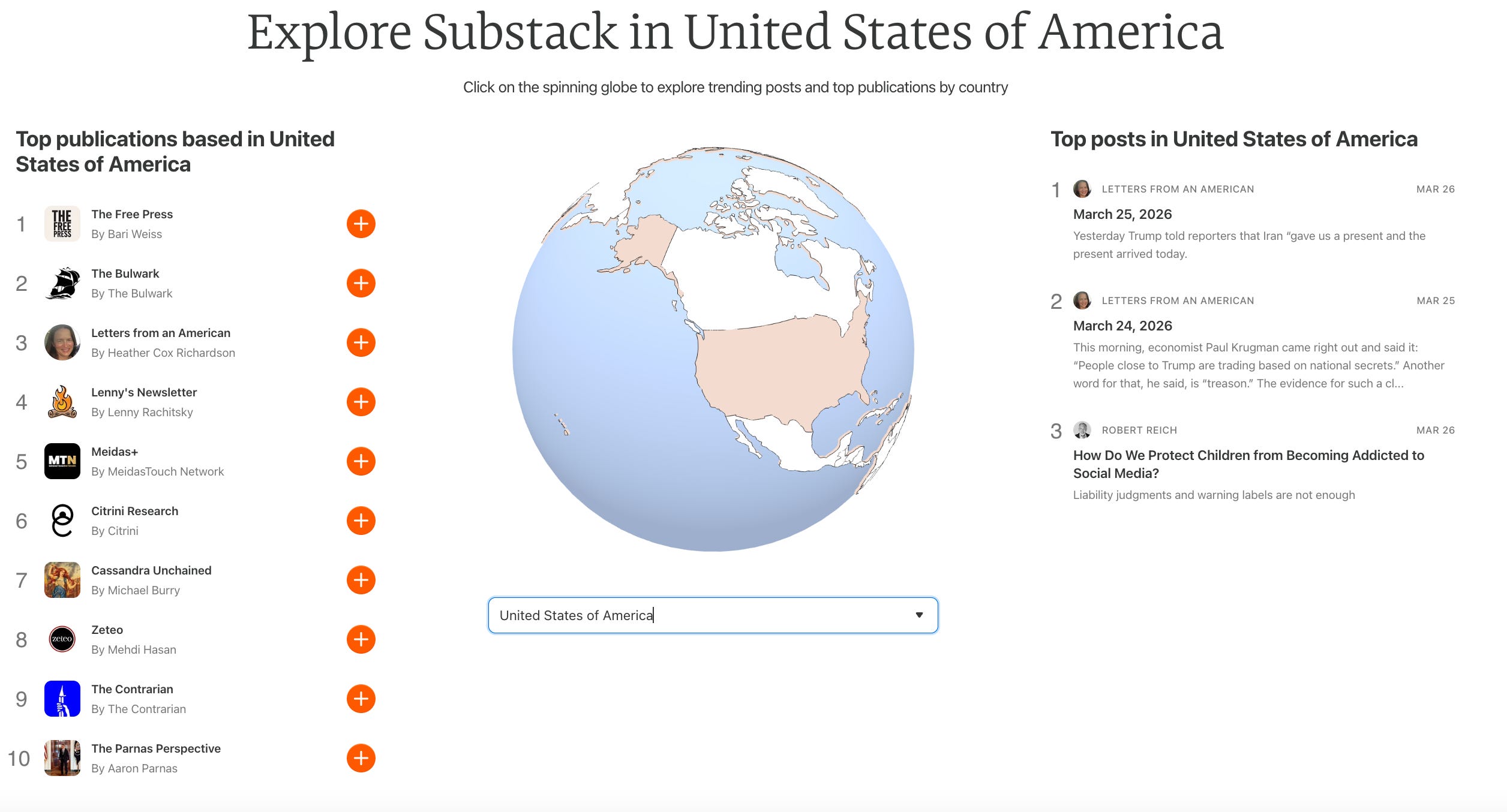
Yeah, that’s not exactly a wide spread. But it’s not exactly surprising, is it?
At a basic level, these categories aren’t necessarily the ones people love most, but the ones that readers feel they need to keep up with. Topics like politics, finance, and news have immediate, real-world consequences, which can create a sense of urgency that humanities subjects simply don’t carry in the same way. They also naturally generate constant updates, making them well-suited to a newsletter format.
But would a strong Substack platform in these categories appeal to publishers and book buyers more than a strong presence on other social media?
Yes. Definitely. Not only does a Substack signify monetizable content, but it proves that the author can consistently produce the kind of in-depth, structured thinking that a book requires. Writing a few viral posts on X can’t prove that.
The same logic naturally extends to other authority-driven nonfiction genres. You might first think of self-help, psychology, health & wellness, popular science, or biographies, but I’d argue that creative nonfic fields like interior design, craft, and travel will follow a similar pattern. For aspiring nonfiction authors in expertise-led genres, having a strong profile on Substack proves that you can write compelling long-form content that readers will pay for.
The exception to the rule
That’s not to say that having a Substack profile is a golden ticket for every nonfiction author, and I’d argue memoirs would be the primary exception.
Memoirs operate on a fundamentally different kind of value than authority-driven nonfiction, which is why the same Substack-to-book logic doesn’t translate as cleanly.
In most authority-driven categories, readers are subscribing to ongoing insight, which can be delivered in installments over time and still retain its value. Memoirs, by contrast, are typically not about repeatable insight but about a singular, cohesive experience.
Readers tend to pick one up because they already recognize the name (i.e. the author is a celebrity, public figure, or someone with a compelling life story) or because the writing itself promises a level of narration, craft, and emotional payoff that can’t be replicated in a weekly email.
For example, even if the author of “Letters From an American” (who currently boasts 2.9M subscribers) decided to pitch a memoir, there isn’t a guarantee that a commissioning editor would bite on that book proposal, or that a book buyer would place an order. (But if she became a guest star on Love Island first, that might be another story…)
So what about fiction genres?
Unless your novel has serious nonfiction bones (say, a historian writing a historical fiction), I’d wager that fiction authors won’t see a huge boost in responses from literary agents just because they have a large Substack following.
That’s because agents are primarily evaluating a fiction submission on the strength of the manuscript itself, not whether people pay to read your weekly day-in-the-life blog.
That said, it doesn’t mean a Substack is a poor investment for fiction writers. Having a profile on any social media platform is extremely valuable. How many times have you seen a random influencer snag a book deal with literally zero writing experience?
There’s also the small but real chance that an agent could discover a writer’s serialized Substack content and see potential for a full-length book. In theory, it’s not dissimilar to the fanfiction-to-published book pipeline that’s fueled some major titles, like Fifty Shades of Grey and Alchemised1.
Growing your Substack profile can also help you spread your name recognition, cultivate a sense of community with readers, and improve your chances of snagging media opportunities down the line.
Plus, many fiction writers might feel more comfortable making content on Substack than on platforms like TikTok or YouTube that might require video and design skills.
To conclude
A big Substack following—paid or unpaid—won’t guarantee every author a book deal, though some genres (like cookbooks) certainly lend themselves to higher chances than others.
But no matter what genre you write in, there’s one thing I can guarantee: being on Substack won’t hurt.
Unsolicited Manuscript is an independently run newsletter. All opinions are my own and do not reflect those of my employer, company, or any other institution.
Please note that not all publishers will accept work that has already been published online. Check publisher websites for submission guidelines.
Thanks for sharing this. I'm a fiction writer, but it's still good to know the viability of this platform.
This is absolute gold, thank you for going into such depth, Abigail. Brilliant insights!