

I'm a Young Creative Professional in NYC. Here's How I Actually Afford Living Here.
A realistic look at building a sustainable creative career in one of the world's most expensive cities

If you’re new here—hi, I’m Abigail! I usually write about books, not financial advice. If you’re interested in writing, reading, and publishing, you’ll probably like my other content, too.
One of the hardest parts about deciding to pursue a creative career is that everyone seems to have an opinion about your finances.
Before I graduated college, I listened to plenty of well-intended warnings about low salaries, impossible rent, and the idea that if I really wanted to work in publishing, I’d have to accept living paycheck to paycheck forever. (Thankfully, none of those comments came from my parents. Shout out Mom & Dad!)
While I knew I loved the industry enough to take the risk, I also wished I had one example of someone living the kind of life I hoped to build: nothing extravagant, just comfortable, sustainable, and genuinely happy without needing to sell out for a job that I knew wouldn’t fulfill me.
Let me be that example for you.
Before I get into it, a quick disclaimer: I work in corporate publishing. So while I’m in a creative industry, I also have a salaried job with predictable hours and income. My experience won’t be identical to someone freelancing, working contract jobs, or building a creative business from scratch.
However, publishing does have a well-earned reputation for low salaries, and that’s an ongoing conversation the industry needs to continue having. This post isn’t meant to dismiss those realities; it’s simply an honest look at how I’ve made a creative career in New York work for me.
#1: I didn’t move without a plan
The biggest financial decision I made happened before I started packing. I accepted a full-time job while still living in California, waited until I had my signed offer letter, and then I started frantically applying for NYC apartments.
Sure, waiting until the last minute probably narrowed down my options and added the stress of a ticking clock (between accepting the offer and my first day on the job, I only had about 15 days to look, sign a lease, AND move), but waiting to have proof of employment let me qualify for my apartment without a guarantor.
It also gave me peace of mind that I wouldn’t have to gamble on drying up my savings waiting for a job offer that might not actually materialize.
#2: I opted for humble housing
Housing is almost everyone’s biggest expense in New York, so it’s also where I had the most control over my budget. I chose to live in Brooklyn with two roommates rather than trying to find a studio or one-bedroom in Manhattan. It isn’t the fanciest apartment in the world, nor the shortest commute to work (about 45 minutes), but it gives me more financial freedom.
Having roommates has never really bothered me, and because I was moving to a city where I literally knew no one, I knew that having a few built-in people to socialize with would be a plus.
I also adore Brooklyn.
Manhattan certainly has its moments, but it’s not someplace I’d want to be in the middle of 24/7. Where I live, the streets are quieter, the grocery stores are slightly less expensive, and there are no skyscrapers blocking light from my windows. For me, those factors all outweigh the convience of a quick commute.
#3: I budget like crazy
My starting salary was $48,000 a year. I knew it wasn’t a lot, but it was also the most money I was looking at in my life so far, so that definitely helped me see it as an opportunity rather than a limitation.
I know creatives aren’t usually the biggest fans of spreadsheets, but boy are they useful (and you can make them look all pretty with fun colored tabs!). Right after moving, I created a monthly budget planner with the following breakdown:
50% for bills (rent, utilities, transportation, phone, and other fixed expenses)
25% for food and fun (groceries, restaurants, hobbies, clothes, activities)
25% for savings (emergency, travel, and retirement)
And. I. Track. Everything.
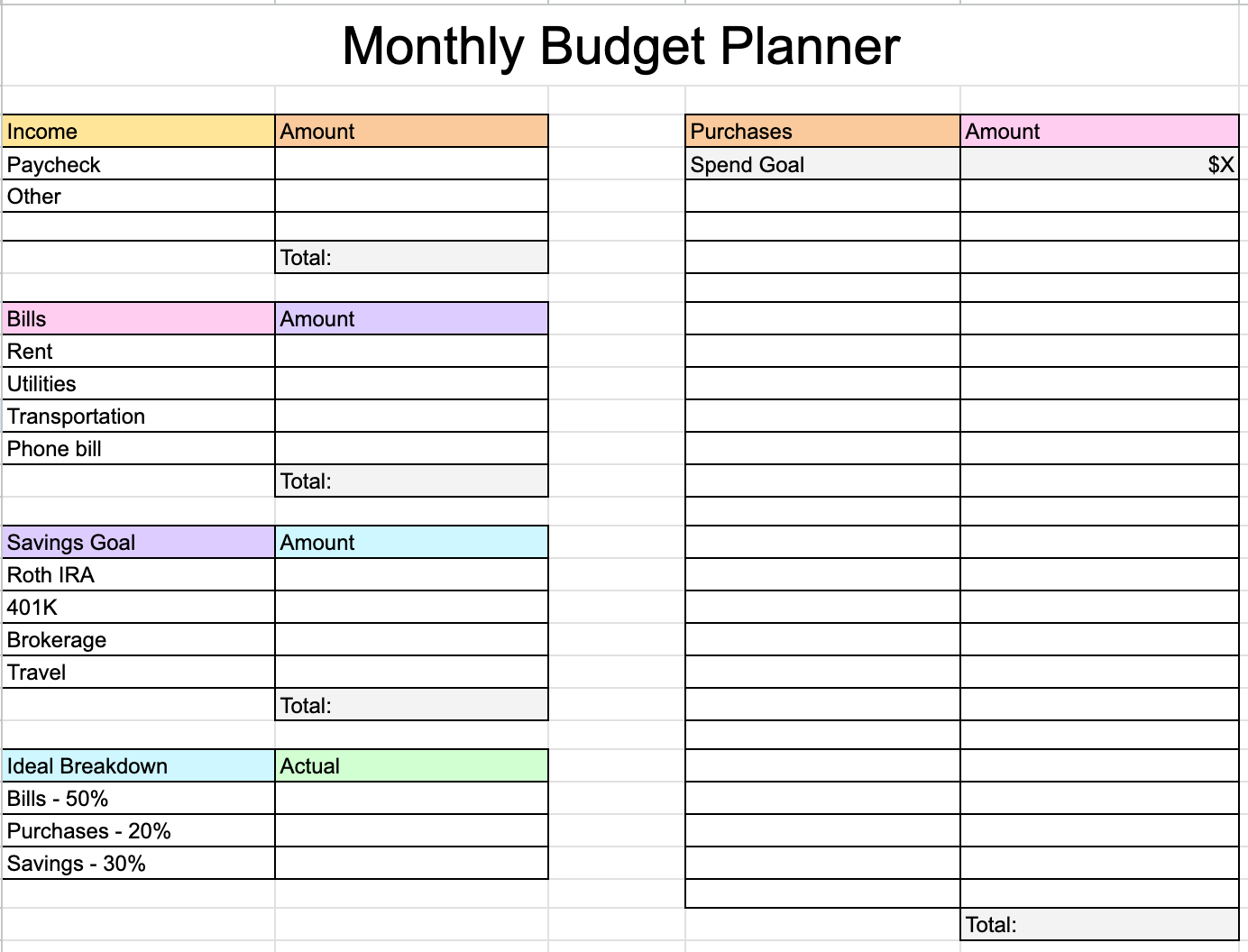
I try to add expenses to the spreadsheet immediately after I tap my card, but tend to forget a bunch and just straighten everything out at the end of the month. It can be a little tedious, but spending blindly is dangerous on a low salary. The extra hour I take to balance out my budget on the 31st is worth never worrying that my card will decline.
One important thing is that I budget based on my take-home pay rather than my salary on paper. Taxes vary by state, but in New York, taxes take around 25-30% of every paycheck. Meaning, that first year, I was only actually bringing home $36K (yikes!).
As my salary increased through raises and changing jobs, I adjusted those percentages. Today, I still spend just under half of my income on bills (yay, health insurance and rent increases), but now I save closer to 30% and dedicate 20% to food and fun.
Every raise has expanded my options, but I made sure they didn’t dramatically change my priorities. Just because I make a little more doesn’t mean I need to go rent a much fancier apartment or sign up for an Equinox membership.
#4: I prioritize low-spend activities
One of the biggest assumptions about New York is that you bleed money just by leaving the house. It’s… sort of true.
There are days when I walk out the door intending to spend nothing, but then I’m invited out to a drink with a coworker, and pick up a carton of raspberries on the way home, and then do my laundry, and then somehow spend $40.
And then there’s the can’t-miss movie tickets, and Broadway shows, and birthdays, and new restaurants, and baseball games, and concerts, and… you get the gist.
To balance this out, I always pack a lunch for work, only eat at restaurants once or twice a month, keep clothing/frivilous spending to a minimum, and try to save drinks with friends for happy hour whenever I can. Once or twice a month, I might grab a tea at a café, but you definitely won’t find me spending $8 on a latte five days a week.
NYC is also the home of dozens of free events every weekend, like live concerts, craft clubs, writing groups, museum and gallery exhibitions, art fairs, farmers markets, brand pop-ups, and more. There are plenty of ways to keep your calendar booked on a budget (and dozens of handy Instagram and Substack creators who compile weekly lists of free activities).
#5: I rebranded saving as a way to buy options
Saving has always been very important to me because that’s how I was raised. As I’ve gotten older, though, I’ve realized that saving money literally buys you freedom.
Knowing you have a financial cushion makes it easier to leave a job that isn’t serving you. It gives you breathing room if your lease ends unexpectedly or you decide to move. It creates opportunities to go on vacation, or buy Christmas gifts, or pay unexpected medical bills, or replace a dead laptop.
But I also recognize that my priorities won’t match everyone’s priorities.
For me, saving has always been high on the list, but someone else might happily spend that same money on a beautiful apartment, dinners with friends, or seeing every Broadway show that comes through town.
Those choices aren’t inherently better or worse—just a little riskier.
#6: I make exceptions
Now don’t get it twisted: the budget is there to support my life, not the other way around.
Most months, my spending follows roughly those percentages I outlined above, but every so often, something comes along that’s absolutely worth bending the rules for. Earlier this year, I tagged a nine-day solo trip around the UK onto the end of a work trip in London. Between trains, hotels, museums, bus tours, theatre tickets, and the occasional nice meal, I spent around $2,000 over those nine days.
Normally, that money would have gone toward my retirement and investment accounts. Instead, I’d intentionally set it aside over the three months leading up to the trip because I knew it was something I really wanted to do. My savings rate dipped for those months, and I didn’t lose a second of sleep over it.
Like going to the gym, a budget doesn’t have to be completely perfect to be effective. If I know a bigger expense is coming, I account for it in advance or smooth things out over the next month or two. As long as those bigger spending months are the exception rather than the norm, they’re just waves in the ocean.
Because while your twenties are great for building financial security, they’re also for saying yes to experiences you’ll remember for the rest of your life.
#7: And I stay unbothered
Because I’ve built a budget that works for me, I don’t spend much time wishing I had a completely different job just because it pays more.
If you’re surrounded by friends who constantly make you feel guilty about earning less than them or for not following a “traditional” career path—spoiler alert: they’re probably not good friends!
I love spending my days working with books alongside other people who are also really passionate about them. Most of my coworkers are crazy creative outside of work, too, and it’s completely normal to start our Thursday morning meeting passing around photos of everyone’s latest project. I love that support.
I’ve also found there’s a great emphasis on work-life balance in corporate publishing (though I’ve heard this isn’t exactly equal across every company), and am grateful to log off work at 5 pm still feeling energized. That’s something I value.
And even if I’m saving a little less each month than someone in a higher-paying field, I’m still making steady progress toward my financial goals. My travel fund is growing, my retirement savings are growing, my someday house fund is growing. Progress is still progress.
There you have it
My experience is only one example, and I know it won’t apply to everyone. Creative careers come with different challenges, different salaries, and different levels of stability.
But if you’re wondering whether choosing a creative career automatically means giving up financial security, I hope this post offers one hopeful perspective.
Unsolicited Manuscript is an independently run newsletter. All opinions are my own and do not reflect the views of my employer, company, or any other organization.
I love this. It sounds like you have a good grasp on how to live. Enjoy your lifestyle instead of chasing someone else's. Good luck.
Tim Suddeth
You are building great habits! I worked for a small literary publisher in Toronto in the 2000s. I made $26k (Canadian dollars). I was very frugal but still had fun and managed to save. Because of those habits I was eventually able to buy my own flat just 20 mins commute into London, England without family help or a husband! I didn’t work in publishing at that point but I would never trade those early years working in my dream job, even if it was for peanuts.