

Everything Authors and Publishers Should Take Away from the 2026 US Book Show
If you couldn't make it, I've got you covered.

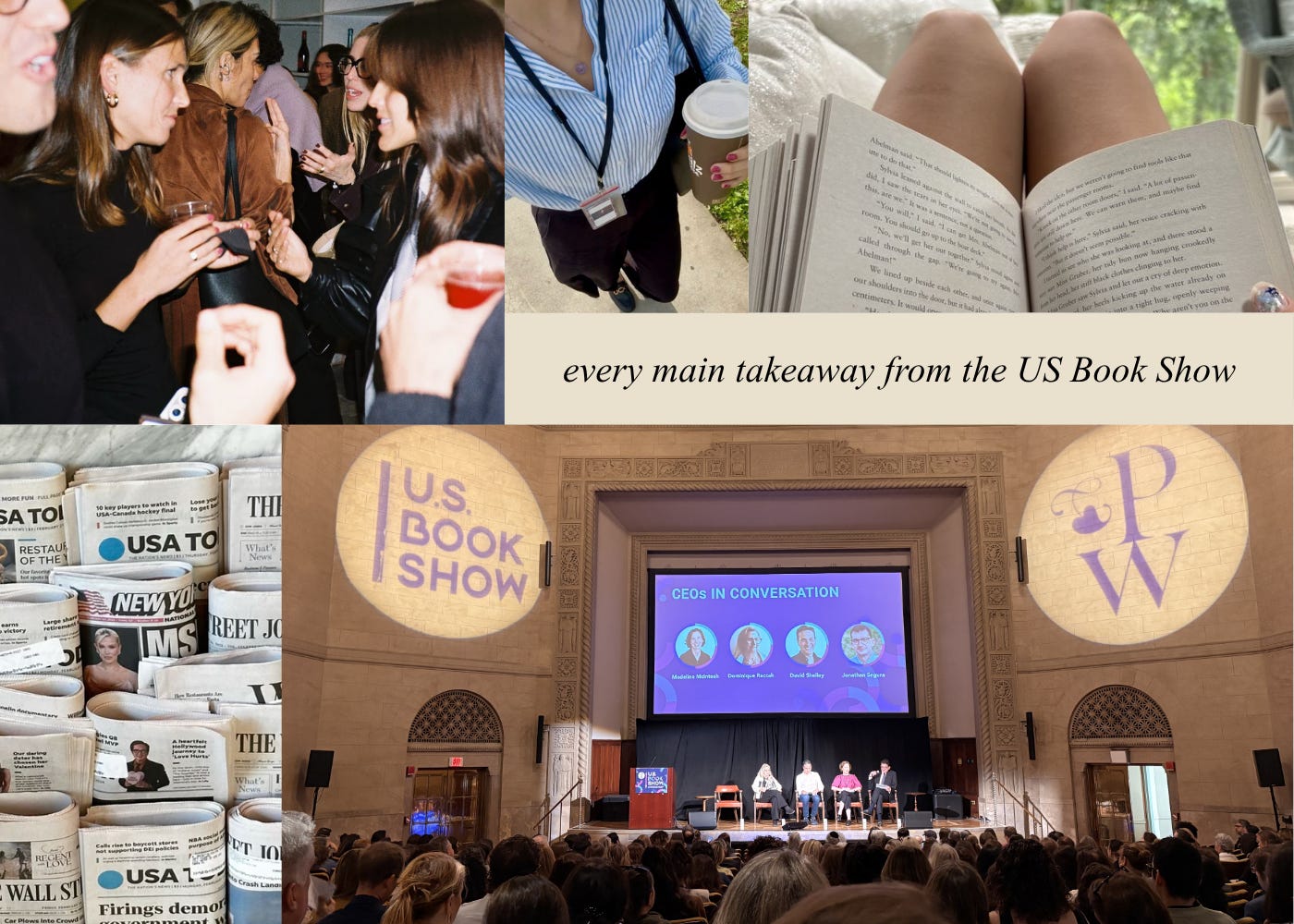
Last week, I attended the 2026 US Book Show, presented by Publishers Weekly. In the span of eight hours, I filled up nine pages of notes on everything from AI discoverability to the future of community-building.
Rather than recap every presentation, I wanted to share the themes that stuck with me most. Many of these conversations reinforced trends I’ve already been aware of, while others challenged assumptions I’ve held. If that’s not a sign of a great conference, then I don’t know what is.
I’ll quickly note that there were simultaneous panels occurring throughout the day, and because I could not be in two places at once, this post is not exhaustive of every topic covered at the show. Generally, I chose to attend those that aligned most with my career interests (PR & digital marketing).
I’ve divided my learnings into two sections, starting with author takeaways. If you’re a publishing professional, feel free to scroll down to Part Two.
Note: It was such a joy to meet some of you in person last week! Thank you to everyone who said hi.
Part One: What Authors Should Take Away
1. Readers care less about trends than we think
One of the most interesting panels centered around data-informed publishing. The panelists argued that trend forecasting has become less useful because everyone has access to roughly the same information. If every publisher is looking at the same keyword reports and bestseller lists, they’re often arriving at the same conclusions.
The example on everyone’s mind was the recent explosion of sports romance. Looking at historical sales data alone would not have predicted this category’s growth, primarily for one big reason: readers weren’t showing up because they suddenly became passionate about hockey, but because they connected with the emotional arcs, beloved tropes, and sense of escapism lining these books.
For authors, this is a helpful reminder that chasing surface-level trends rarely leads to hitting the sales jackpot. The more valuable question is: what underlying need is this book fulfilling for readers?
A trend may fade, but the reader desires underneath (for hope, transformation, entertainment, connection, escapism, etc) will stick around.
2. Build a community, not just an audience
Substack came up multiple times throughout the conference, which wasn’t surprising. What was interesting was how frequently speakers emphasized community over audience growth.
The strongest author communities tend to share a few characteristics:
A distinct point of view
A willingness to engage in conversation
Consistent participation
Content that reflects the author’s personality and interests
Many authors approach platform-building as a broadcasting exercise. They post updates, share news, and hope readers pay attention. The authors seeing the most success are often creating spaces where readers can participate.
That participation can take many forms, beyond just Substack. It might be newsletter comments, reader surveys, Facebook groups, Discord communities, Reddit discussions, or simply asking thoughtful questions on social media and responding to the answers.
Try to make your platform an interactive space.
3. Your platform should tell a consistent story
One session focused heavily on AI-powered discovery and how recommendation systems are evolving. While much of the discussion centered on retailer and publisher responsibilities, there was an important takeaway for authors:
Consistency matters.
Your website, author bio, retailer pages, newsletter, and social platforms should all communicate a similar picture of who you are and what you write. In fact, AI conflates consistency with authority. If your channels share the same information (or even the same exact copy), AI is more likely to cite you as a source and recommend your books.
When AI crawls one of your platforms (and I know that sounds creepy, but it’s in your best interest to make sure you don’t have crawling disabled!) and then visits another, it should immediately understand:
What kinds of books you write
Who those books are for
What topics and themes you explore
What makes your perspective unique
For more tips on AI and integrating GEO into your platform strategy, check out this post.

4. Read your reviews
One of my favorite pieces of advice from the conference had nothing to do with algorithms. It’s this: read your reviews.
Now I don’t mean you should obsess over ratings or dwell on criticism. Read them because readers are constantly telling you how they describe your work to other people. Oftentimes, their descriptions will be more natural and authentic than whatever copy your marketing team came up with.
Reviews often reveal:
Which themes resonate most strongly
Which aspects readers remember months later
Which audiences are recommending the book
What language readers naturally use when discussing it
That information can be surprisingly useful for future marketing, future books, and future positioning. It can also give you insight into what readers are yearning for next!
5. Publication day isn’t the finish line
Several sessions touched on long-term discoverability, and I found myself nodding along.
Publishing still tends to focus enormous energy on launch week. Meanwhile, many books find their audience months or even years after publication. I mean, half the books “trending” on TikTok are seasons out of date!
The point is, authors who continue talking about their books after launch can create additional opportunities for discovery. If a news story relates to your topic, share your perspective. If a film adaptation sparks conversation around a theme you explore, join the discussion. If readers are finding new relevance in your work, help amplify those conversations.
Don’t just assume you can ride the wave of launch momentum for years to come.
Part Two: What Publishers Should Take Away
1. Data has limits
Like I mentioned above, data is useful, but it’s only one piece of the puzzle.
Several speakers suggested that publishers should spend more time understanding reader motivations and less time chasing categories that appear to be trending. One proposed solution was placing greater emphasis on reader surveys, and I’m interested to see whether that becomes more common in the years ahead. Data can tell us what people are buying, but surveys have the potential to reveal why they’re buying it, and what they’re looking for next.
At PRH, we already have initiatives like The Reader Lounge, and I’m sure other major publishers have similar programs. What struck me, though, is that many of these panels also suggested that imprint identities will need to become increasingly distinct as AI discovery rewards clear positioning (thanks, GEO!).
It makes me wonder whether we’ll eventually see more imprints conducting their own reader surveys, much like many already run their own influencer programs.
2. Booksellers remain one of publishing’s best sources of intelligence
One point that came up repeatedly was the value of bookseller insight.
Booksellers spend their days talking to readers, recommending titles, observing browsing behavior, and identifying emerging interests before those interests necessarily show up in reporting systems.
They are essentially on-the-ground reporters who engage directly with publishers’ target audiences on the daily. Any imprint whose acquisition, marketing, and publicity teams aren’t taking advantage of bookseller feedback is losing out on perhaps the most valuable data of all.
3. AI discoverability is becoming impossible to ignore
If there was one topic that dominated conversations, it was AI (are you surprised? No? I didn’t think so).
A significant portion of the discussion focused on Amazon-specific discoverability and how retailers can improve their books’ chances of being recommended by Alexa (AKA, the new hyper-tailored algorithm that listens to your conversations and predicts your next purchase. See you later, Rufus).
Several recommendations surfaced repeatedly:
Maintain consistent descriptions across platforms
Ensure author bios align across websites and retailer pages
Invest in video content for retail listings and author pages (this was extremely emphasized)
Use clear, descriptive language (bullet points/FAQ pages are your friend for this)
Describe what the reader will take away from purchasing a book, not just what the book is about
The broader theme was that discoverability is becoming more semantic and contextual. Systems are looking for clarity, relevance, and consistency rather than keyword-heavy optimization, needless amounts of blurbs, or flowery prose.
4. Community-building deserves more investment
Another theme was the growing value of owned communities.
The conversation extended far beyond social media follower counts. Panelists discussed Kickstarter campaigns, Facebook groups, Reddit threads, Substack publications, and direct reader engagement.
Unsurprisingly, the most successful examples involved readers feeling invested in a project long before publication.
The publishers who successfully cultivate engaged communities (that’s right, no more slacking on publisher social media platforms!) and encourage their authors to do the same, from the moment the book deal is signed, will find themselves with a significant advantage.
5. We need to think beyond the frontlist
One of the more practical conversations centered around backlist discovery.
Publishers devote enormous resources to launching new books, then move on to new books the second that the next season arrives. It’s just the way things are done.
But… maybe it shouldn’t be. The majority of publisher sales come from backlist titles, and it’s time to rethink this old model.
Several suggestions stood out:
Monitor backlist reviews for recurring themes
Refresh metadata and sales copy when appropriate (see above on reading reviews!)
Connect older titles to current events and cultural conversations (such as movies or big news events dominating conversations)
Feature backlist books more frequently on publisher platforms (like starting a “Backlist Wednesday” series on Instagram)
Final Thoughts
If I had to summarize this year’s US Book Show in a single sentence, it would be that publishing is becoming more relationship-focused (and I don’t mean chasing follower counts), not less. Even conversations about AI ultimately drifted back to understanding reader communities more clearly.
Which is good news for those of us who believe that the best marketing strategy is (and always has been) readers telling a friend, “You need to read this.”
Unsolicited Manuscript is an independently run newsletter. All opinions are my own and do not reflect the views of my employer, company, or any other organization.
This was very insightful! Thank you so much for taking the time to share 👏🏻🙏🏻!
Love the "read your reviews" bit. I read my reviews, but I didn't think of reading through the lens of gleaning content creation ideas to further promote my book. Thanks!